

Key Takeaways
- NPK numbers show the proportions of nitrogen, phosphorus, and potassium in a fertiliser, helping you understand its nutrient profile.
- Nitrogen mainly supports leafy growth, phosphorus supports root development and flowering, and potassium supports water regulation, plant processes, and overall resilience.
- The right NPK ratio depends on your plant type, growth stage, growing medium, and current conditions, not simply on choosing the highest numbers.
- Foliage plants, flowering houseplants, succulents, cacti, and orchids have different feeding needs, so match fertiliser choice and application to how each plant grows.
- Fertiliser is only one part of plant care. Before treating slow growth or changes in your plant as a nutrient problem, consider light, watering, root health, placement, and application rate.
Introduction
Walk down the gardening aisle or browse plant fertiliser products online, and you will quickly notice labels such as 10-10-10, 20-20-20, or 3-1-2. These NPK numbers are one of the first things you will see on a fertiliser package, but they can be confusing if you are new to plant care.
Choosing the right fertiliser isn’t about picking the product with the highest numbers. Different plants have different nutritional needs, and the most suitable NPK ratio depends on the type of plant, its stage of growth, and how it is being grown.
Understanding NPK and what the different NPK numbers mean can help you make more informed choices when feeding your plants. This is particularly useful when caring for indoor plants in Singapore, where growing conditions can vary considerably depending on light, placement, and the indoor environment.
Understanding NPK Ratios
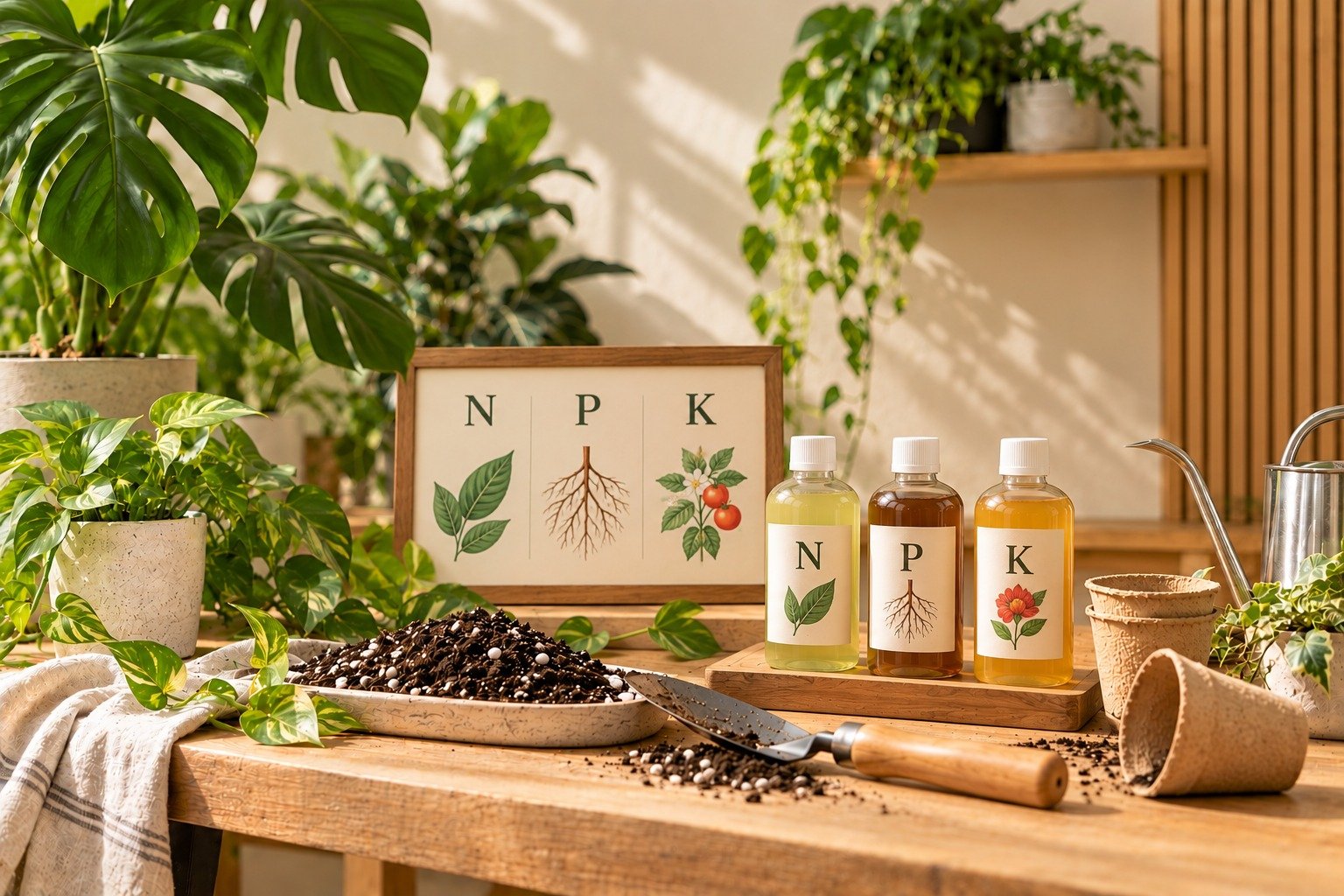
NPK stands for the three primary nutrients that plants require in the largest amounts: nitrogen (N), phosphorus (P), and potassium (K). The NPK numbers on a fertiliser label represent the proportion of each nutrient in the product.
Nitrogen supports leafy,green growth and plays an important role in producing chlorophyll, which plants use during photosynthesis. Fertilisers with relatively higher nitrogen levels are often chosen for foliage plants grown primarily for their leaves.
Phosphorus supports healthy root development and promotes flowering, fruiting, and seed production. While every plant needs phosphorus, those grown for flowers or fruit may benefit from formulations designed to support these growth stages.
Potassium helps regulate many essential plant processes, including water movement, enzyme activity, and overall plant resilience. It contributes to stronger stems and supports plants as they respond to environmental stress. Nitrogen, phosphorus, and potassium work alongside other essential plant nutrients, so healthy growth depends on overall nutrient availability rather than NPK alone.
A balanced NPK fertiliser such as 10-10-10 supplies equal proportions of all three nutrients, while other formulations emphasise one nutrient more than the others, depending on the intended use. The NPK numbers describe nutrient concentration rather than indicating whether one fertiliser is universally better than another.
Matching NPK Ratios to Common Indoor Plants
The most suitable NPK ratio depends on what your plant is trying to achieve, not on a single formula for every species. The examples below can help you interpret fertiliser labels, but don’t treat them as fixed prescriptions, since concentrations and recommended application rates vary by product.
Foliage Plants
Indoor plants such as Monstera, Philodendron, Pothos, Syngonium, and Aglaonema are primarily grown for their leaves. A balanced formulation, such as one with equal proportions of the three nutrients, may suit many plants, while products with a modestly higher first number place greater emphasis on nitrogen. The right choice still depends on the individual plant and feeding instructions.
Flowering Houseplants
Plants such as Peace Lilies, Anthuriums, and African Violets need balanced nutrition year-round. During active flowering, you may come across formulations intended to support blooming, but a higher phosphorus number does not necessarily mean the fertiliser will encourage more flowers. Light, plant maturity, and overall growing conditions also influence flowering.
Succulents and Cacti
Succulents and cacti grow more slowly than many tropical houseplants and generally require less frequent feeding. A balanced fertiliser applied according to the recommended schedule may be sufficient. More concentrated feeding is not necessarily better, as excess fertiliser can contribute to salt build-up in the growing medium and potentially affect sensitive roots.
Orchids
Orchids are commonly grown in bark-based or other free-draining growing media with limited natural nutrients. Many growers use fertilisers developed specifically for orchids because their feeding instructions and formulations suit these growing conditions.
Choosing the Right NPK Ratio for Your Plant
If you are looking at fertiliser for sale, the NPK numbers are useful for comparing nutrient profiles, but they should not be your only consideration. Your plant’s species, current growth, and overall growing conditions can all influence which option is appropriate.
Start by identifying the plant species and whether it is primarily grown for foliage, flowers, or fruit. This provides a useful indication of its nutritional priorities.
Next, assess whether the plant is actively growing. Nutrient demand can change when growth slows because of lower indoor light, a change in placement, prolonged time in an air-conditioned environment, or stress after repotting. Feeding should therefore reflect how the plant is actually growing rather than following the calendar alone.
Also consider the growing medium. Fresh soilless potting mix or other growing media may already contain nutrients, depending on the product, which may reduce the need for immediate fertilisation. Older growing media may become depleted after repeated watering and continued plant growth.
Finally, observe how your plant responds rather than relying entirely on fertiliser labels. Pale leaves, slow growth, or reduced flowering can sometimes point to a nutritional issue, but they can also result from unsuitable watering, insufficient light, root problems, or other growing stresses. Review the plant’s overall care conditions before assuming that changing or increasing fertiliser is the solution.
Remember that the correct application rate matters as much as the nutrient ratio. Even a suitable fertiliser can cause problems if you apply it too frequently or at a higher concentration than recommended.
Conclusion
NPK ratios provide a useful way to understand a fertiliser’s nutrient balance, but they are only one part of choosing appropriate plant nutrition. Your plant type, current growth, growing medium, environment, product concentration, and application rate should all inform how you feed it.
At Arbour, you can compare NaturalGro® fertiliser options based on your plant type, feeding purpose, and existing care routine. Rather than choosing solely by the NPK ratio, you can consider the intended use and application guidance to find an option suited to your indoor plant needs.
Browse Arbour’s NaturalGro® range or contact the team for help choosing a fertiliser that fits your plants and care routine.
